
“Advanced treatment.”
“World-class care.”
“State-of-the-art facilities.”
“Your health is our priority.”
Most hospital advertisements use the same phrases. Replace the hospital logo, and the advertisement could belong to almost anyone.
That is the problem.
A 2025 FICCI–EY-Parthenon report found that 83% of Indian patients seek objective, accessible information when making healthcare decisions. Nearly 90% of those patients said they would consider paying more for certified quality.
Yet many hospitals continue publishing festival greetings, stock photographs, discount packages and vague claims that tell patients almost nothing.
An effective hospital marketing strategy India can trust must stop advertising adjectives and start presenting evidence.

Why Generic Hospital Advertising Fails
Healthcare is not a casual purchase. Patients are not choosing a shampoo, restaurant or weekend hotel.
They may be worried about:
- Whether the doctor has handled similar cases
- Whether the suggested procedure is necessary
- How long recovery could take
- What the treatment may cost
- Whether insurance or cashless facilities are available
- What happens if treatment is delayed
- Whether the hospital can manage complications
A generic advertisement saying “We Care for You” answers none of these questions.
It may look polished, but polished confusion is still confusion.
Patients usually search for hospitals when they are anxious, uncertain or under time pressure. If your communication does not reduce that uncertainty, they will continue searching, ask relatives or choose the hospital whose information feels clearer.
A Better Hospital Marketing Strategy India Needs
A fact-led hospital marketing strategy does not turn healthcare into aggressive selling. It helps patients understand their options and make informed decisions.
Hospitals should build communication around five areas.
1. Show Relevant Clinical Expertise
Do not simply say, “Experienced doctors.”
Explain:
- The doctor’s speciality and recognised qualifications
- Conditions commonly evaluated or treated
- Available diagnostic or surgical capabilities
- The clinical team involved in complex cases
- When a patient should seek consultation
The goal is not to exaggerate authority. The goal is to make genuine expertise understandable.
2. Explain Treatments in Patient Language
Patients rarely search using perfect medical terminology.
They search questions such as:
- Why does my chest hurt while climbing stairs?
- Does every kidney stone require surgery?
- How long does knee replacement recovery take?
- When should a child’s fever become concerning?
- What happens during an angiography?
Create articles, short videos, FAQ pages and doctor-led explanations around these real questions.
Good healthcare content should explain the condition, possible warning signs, diagnostic process, treatment options and appropriate next step. It should educate without diagnosing strangers through social media.
3. Replace Empty Claims With Verifiable Facts
“Best hospital” is a claim.
“NABH-accredited facility” is a fact.
“Advanced cardiac care” is vague.
“Twenty-four-hour cardiac emergency support with an equipped critical-care team” is useful.
Depending on the hospital and applicable communication guidelines, patients may benefit from information about:
- Accreditations and certifications
- Doctor qualifications
- Available technology
- Emergency availability
- Department operating hours
- Insurance and cashless support
- Appointment processes
- Treatment preparation
- Recovery and follow-up systems
- Patient safety protocols
Facts give patients something concrete to evaluate.
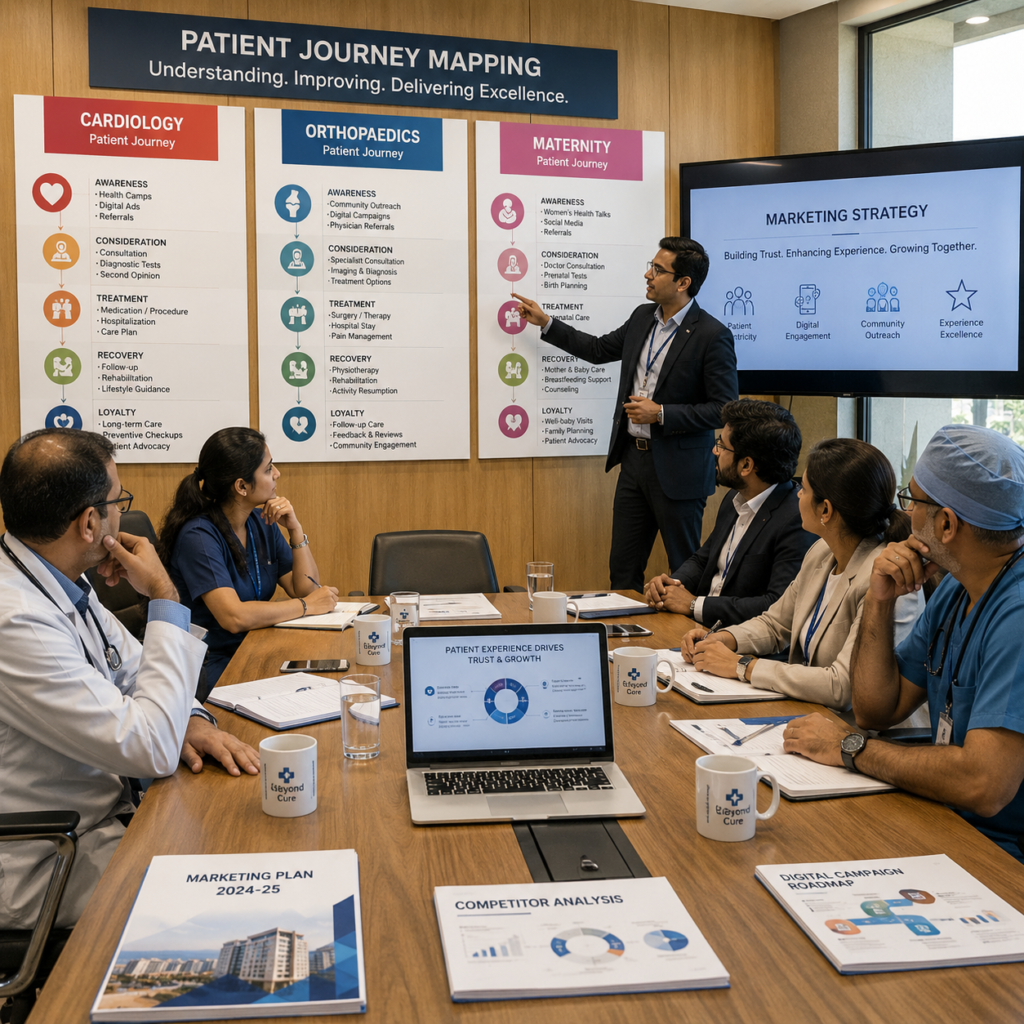
4. Build Department-Specific Marketing Systems
A hospital cannot effectively market cardiology, oncology, orthopaedics, maternity and emergency care using one generic campaign.
Each department has different patient fears, decision cycles and referral patterns.
For example, a cardiology campaign may focus on warning symptoms and emergency readiness. An IVF campaign may need to address emotional stress, treatment stages and financial clarity. Orthopaedic marketing may focus on mobility, treatment options and recovery expectations.
Every major department should have its own:
- Patient personas
- Search-intent topics
- Educational content plan
- Landing page
- Enquiry-handling script
- Appointment follow-up process
- Retention and referral system
Practical Ways to Make Hospital Marketing More Credible
Hospitals do not need to double their advertising budget. They need to stop wasting the current budget on content patients ignore.
Start with these actions:
- Audit the hospital website for vague or unsupported claims.
- Create one detailed page for every priority department.
- Record doctors answering the ten questions patients ask most frequently.
- Publish clear appointment, preparation and follow-up instructions.
- Train reception teams to answer enquiries consistently.
- Track enquiries by department, source and appointment status.
- Analyse where patients disappear between enquiry and consultation.
- Collect feedback about clarity, waiting experience and follow-up.
- Turn common patient confusion into future educational content.
This changes marketing from a poster-production activity into a measurable patient communication system.
Marketing Must Continue After the Lead Arrives
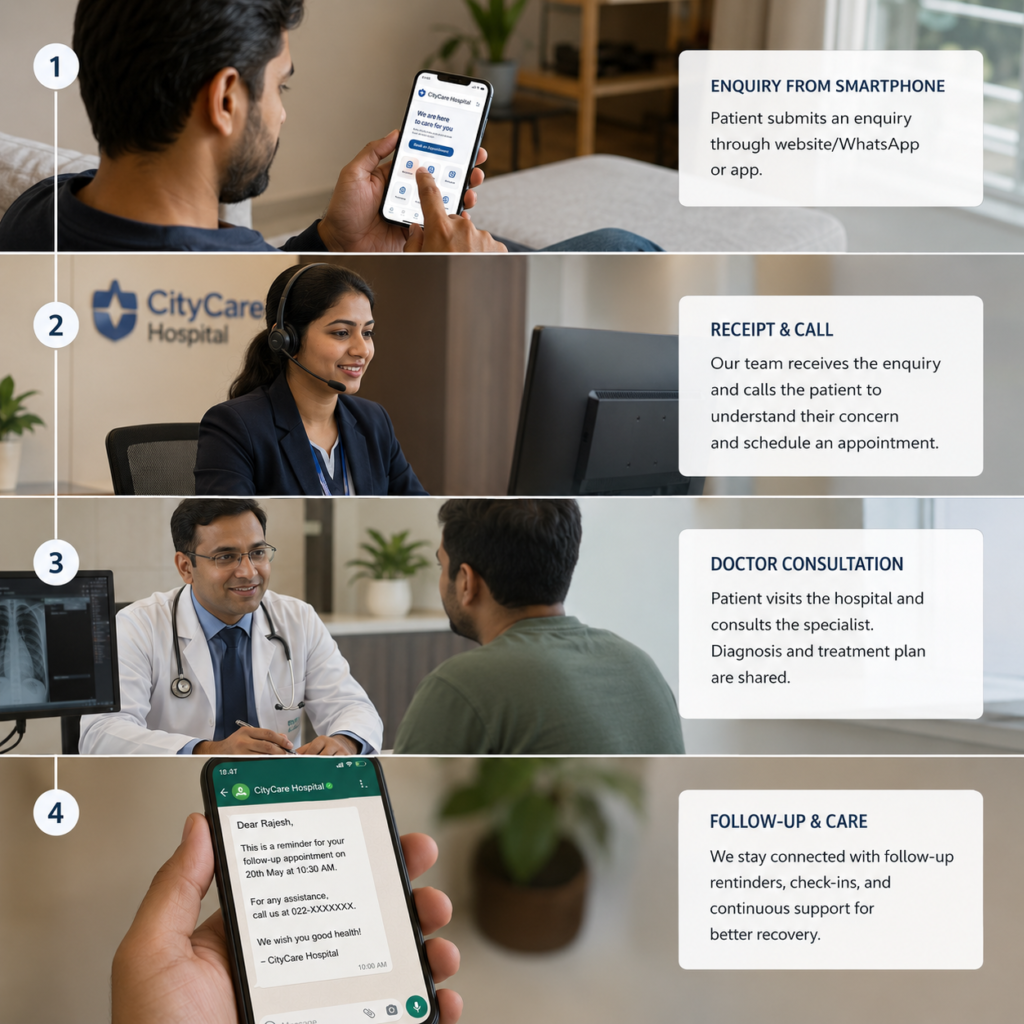
Many hospitals think the campaign ends when someone sends a WhatsApp message.
It does not.
The patient still needs:
- A timely response
- A clear explanation of the relevant department
- Doctor availability
- Appointment options
- Location and preparation instructions
- A reminder before the visit
- Follow-up guidance after consultation
Running ads without fixing enquiry handling is like filling a bucket with a hole in the bottom—and then blaming the tap.
Your marketing performance depends on the complete patient journey, not merely impressions, clicks or lead volume.
Conclusion: Stop Promoting the Hospital and Start Helping the Patient Decide
Patients are not asking hospitals for louder promotions. They are asking for clearer information.
The strongest hospital marketing strategy India can adopt is built on clinical credibility, transparent communication, department-specific education and disciplined enquiry follow-up.
Generic advertising may create visibility. Facts create confidence.
And in healthcare, confidence is what moves a patient from searching to booking, from consulting to continuing treatment, and from receiving care to recommending the hospital.
MedNovera helps hospitals, clinics and diagnostic centres replace disconnected advertising with structured patient-acquisition, conversion, retention and referral systems.
Stop spending more money promoting vague claims.
Start building a marketing system patients can understand and trust.
Book a Hospital Marketing and Patient Acquisition Audit with MedNovera.